

I’m a communicator, designer, and writer. I tend to work in the space where ethics, public meaning, and human systems overlap… maybe collide. I’m still figuring out the right word for that.
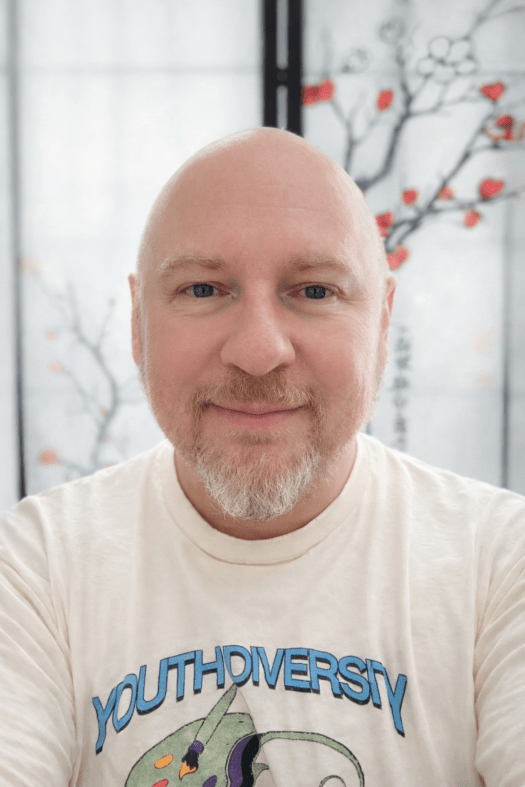
This T-shirt was given to me in 1994, just as I arrived in Vancouver, Washington, from Russia. I was 18 when my high school art design teacher brought me into a youth-led community mural project downtown. It came together through Vancouver School District and community partners. A lot of coordination, a lot of goodwill. We painted one word on a public building: COMMUNITY. At the time, my English was very limited. I didn’t understand most conversations happening around me. What I did understand was being a part of something bigger. Working alongside other people. Trying to find my place in the culture. Being trusted with a task that mattered to more than just me. That became my foundation. More than thirty years later, I still come back to that moment when I think about community and communication. About belonging. About responsibility. About what it means to take part in something that’s meant to be shared.
I was born and raised in Angarsk, Russia, and now live in the Pacific Northwest. Somewhere in between those two places, I exist as an ally amongst aliens, alien amongst allies.
I’ve spent much of my path suspended between belonging and estrangement, close enough to understand, yet too different to blend in. In institutions built on ideals of inclusion, I’ve often found the quiet irony of being both the advocate and the anomaly. But perhaps that’s where the real work begins: in the in-between, where empathy meets resistance and transformation begins to stir.
Over time, I began to pay close attention to how people behave, how institutions speak, how they make decisions, and how they explain themselves. Or don’t. Very much like individuals, institutions have a patterned voice heard through press releases, policies, emails, mission statements, apologies, or the lack thereof.
Migration, family history, and long exposure to systems that affect people within them helped me understand and shaped my listening. Over time, I found myself less interested in persuasion and more interested in responsibility. Not just what gets said, but what gets protected. And what quietly gets neglected. So my appreciation for communication grew.
How I Work
I approach communication as a practice, not a tactic.
Whether I’m writing, designing, or supporting a project, I pay attention to context, power, and consequence. Sticks and stones break my bones, but context works in silence. I’m interested in how language shapes belonging, how systems reward some voices while muting others, and how ethical clarity is maintained when things are messy and pressured.
A lot of my work involves slowing things down. I look for moments where urgency replaces thought, where certainty overrides care, where efficiency starts costing trust. I’m not trying to simplify reality. I’m trying to make it more navigable. That feels different.
Background and Foundations
My background includes formal study in Digital Technology and Culture and Strategic Communication, along with years of applied work in design, production environments, and community-centered initiatives. I’ve worked across academic, professional, and volunteer settings. Often in the in-between spaces where translation is required. Translating between groups with different priorities, languages, or assumptions.
I’m fluent in English and Russian. I bring a multicultural perspective that shows up less as a credential and more as a way of noticing things. Especially around equity, access, and representation. In institutions, yes. But also in everyday interactions, where those issues tend to surface quietly.
Writing and Reflection
Writing plays a central role in my work. Some of what I publish is analytical. Some of it is personal. Much of it sits in between. I write to examine moral tension, to document lived experience, and to question easy conclusions. Family memory shapes a lot of this. So does ethical inquiry. So does watching how public discourse shifts when people feel afraid, rushed, or certain they’re right.
This site exists as a record of that thinking over time. Not a snapshot. More like a trail.
What This Site Is, and Is Not
This is not a portfolio in the traditional sense. It is also not a résumé stretched into paragraphs. I prefer to organize it as a curated body of work that brings writing, projects, and academic foundations into context.
I don’t present work as individual or isolated accomplishments. I place it alongside the conditions it emerged from. The constraints. The tradeoffs. The values. Not to impress, but to be understood.
Some of my work is public, some is not. That boundary is intentional. It’s part of how I think about care and responsibility. About how my voice is projected to the public space in care for others.
And in Closing…
I value thoughtful conversation, collaboration that is not performative, and work that is grounded in clear intent and respect. If something here resonates, you are welcome to reach out.
Thank you for taking the time to read.
 Mikhail Oparin