
On a different note…
Sometimes creativity doesn’t begin with a blank canvas. Sometimes it begins with an impulse purchase, a quiet dissatisfaction, and the sense that something cute but average is asking to become something more.
During the holidays, while preparing our home for celebration, I kept returning to our accent wall. It was nice. Balanced. Finished enough. But something was missing. So I did what many of us do, I started browsing home décor, looking for a way to elevate the space.
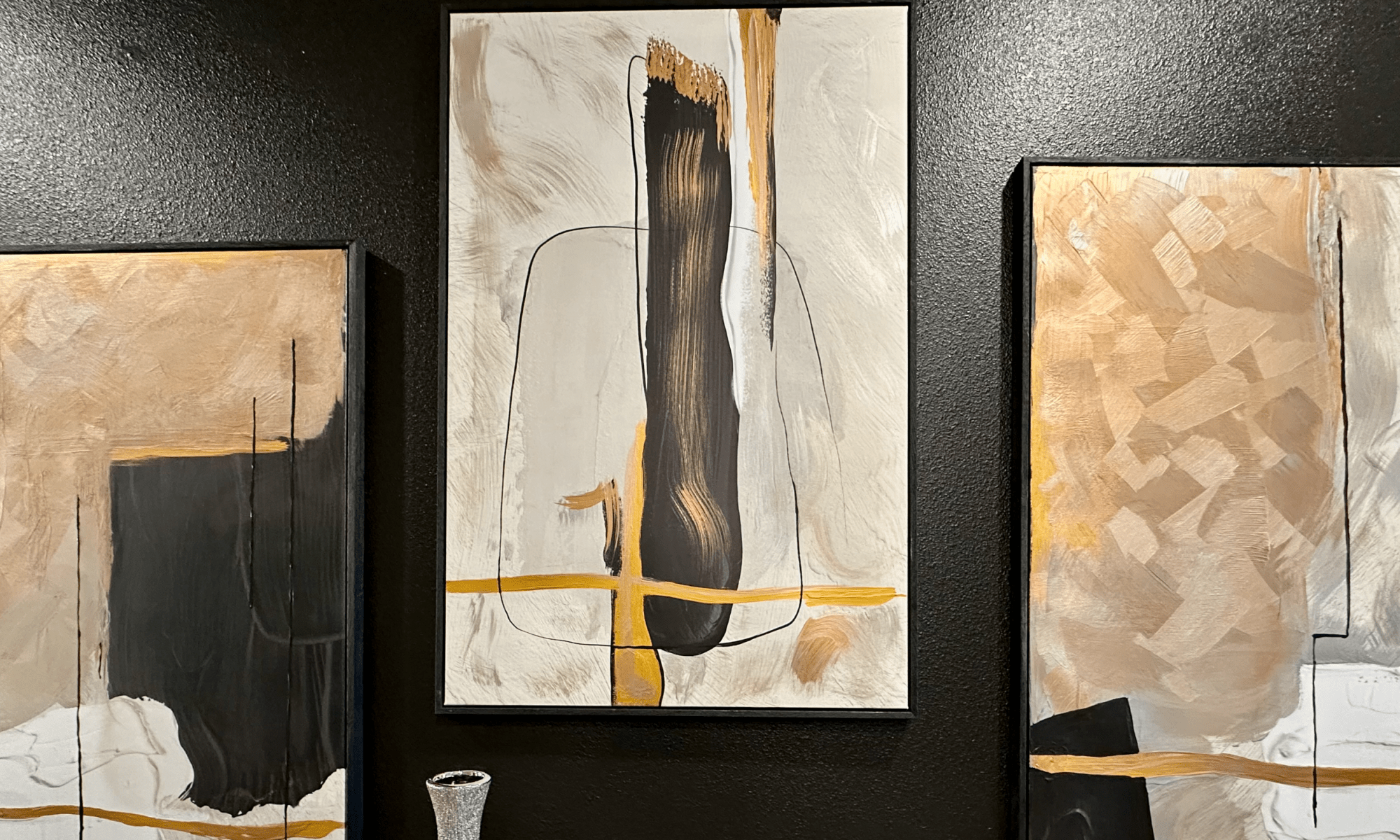
That is how this triptych entered our home.
Originally, it was a mass-produced abstract artwork purchased online. Visually pleasing. Modern. Neutral enough to live comfortably on a wall. And yet, it felt unfinished. Too polite. Too silent. It occupied space, but it didn’t speak.
So I listened. To my own response. To my instincts. To what the work was not saying yet.
What followed was transformation.
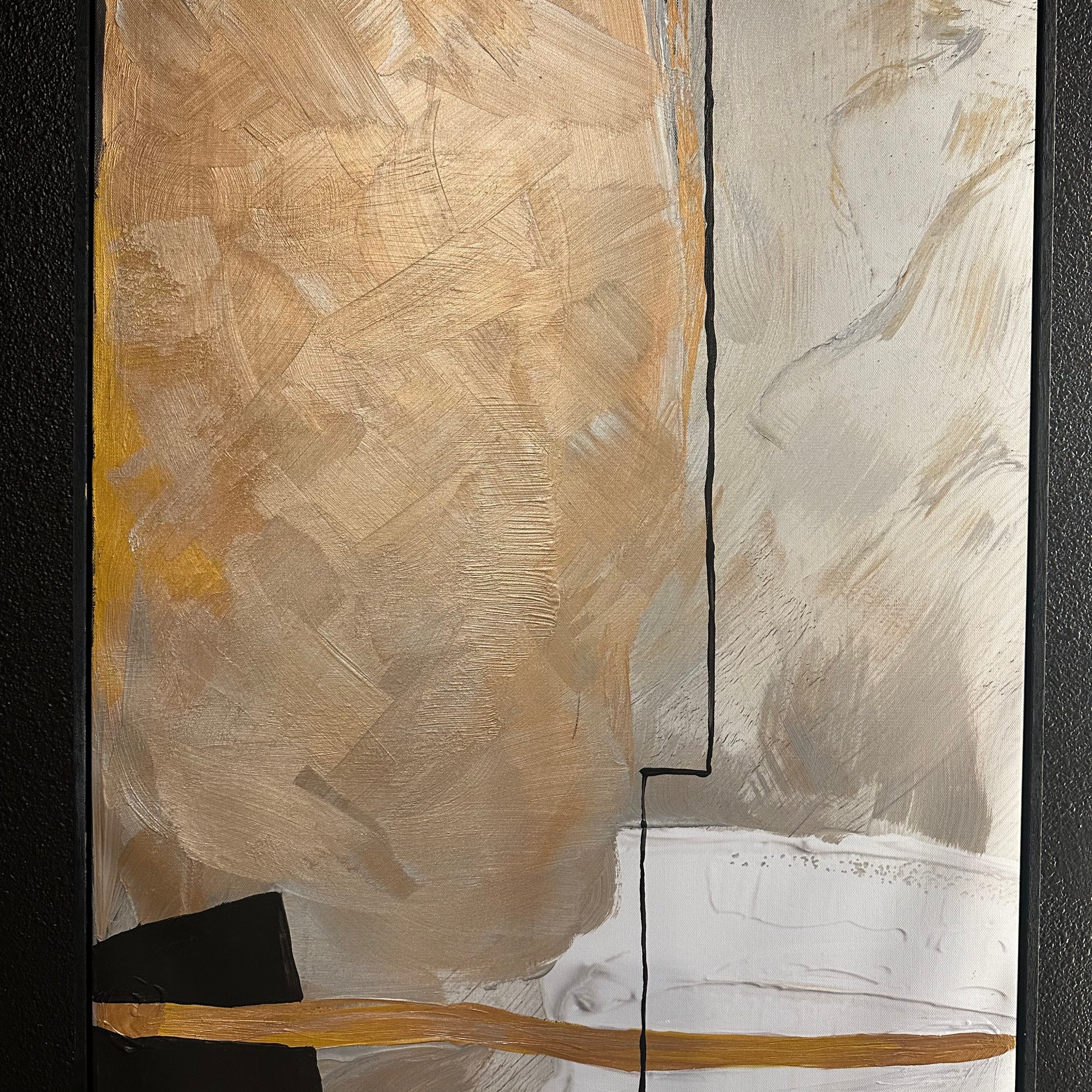
Over the course of several days, I began engaging with the work directly. I layered fresh lines shapes and texture over the original introducing gold, silver, and bronze paint left over from my son’s bedroom accent wall project. These additions created tension, reduced flatness of the original creative, and began to reshape the tryptic into a silent but defining narrative. Metalic paint became textured and expanded, it began to shape the narrative. Thin black lines were introduced slowly and deliberately to the side panels, as gestures instead of borders. Texture was emphasized. Silence was shaped.
The result was no longer decorative. It turned into one of a kind, no longer anonymous artwork. It began to speak to me.
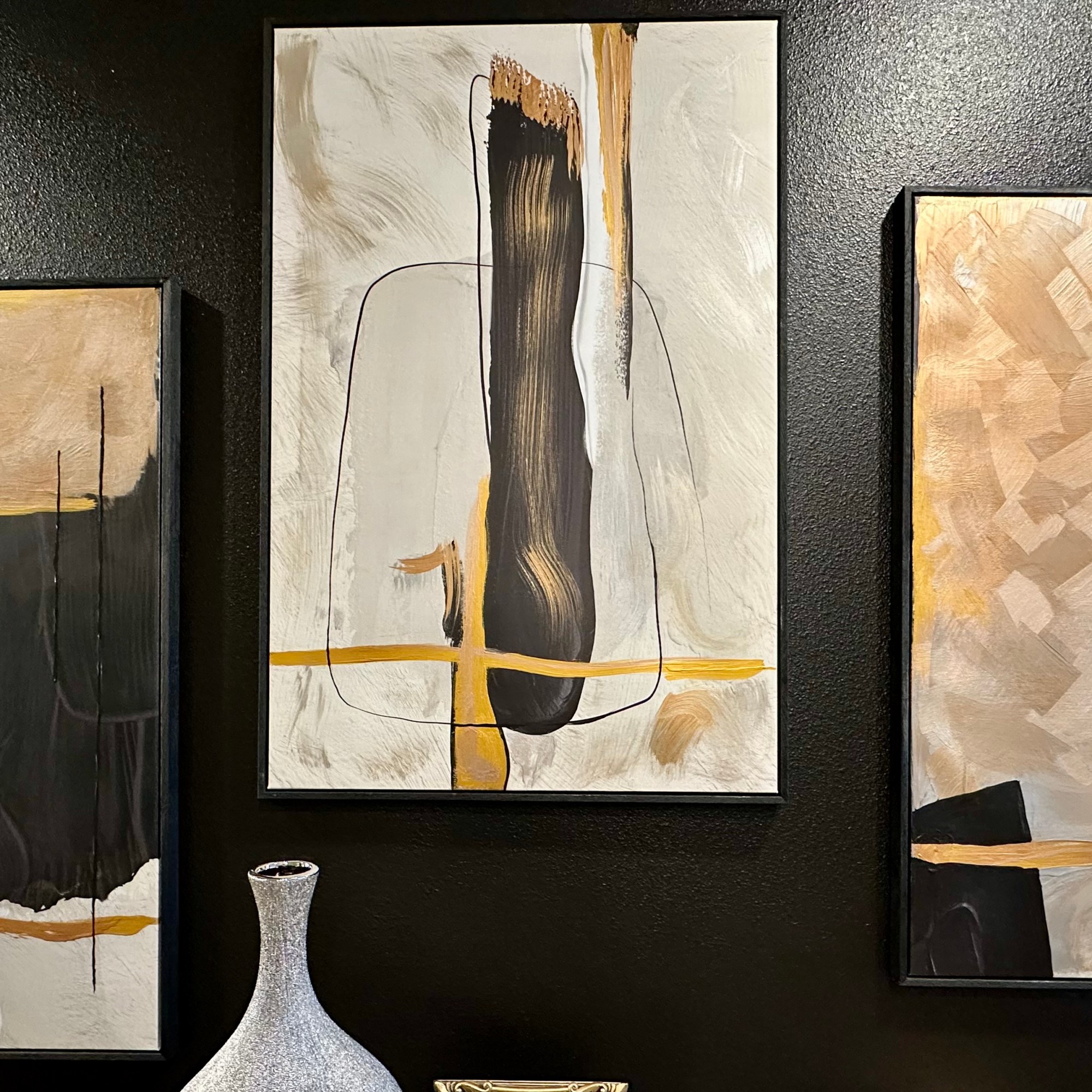
After finishing, I found myself returning to it repeatedly, often standing in front of it for extended periods of time. What emerged in the center panel was unexpected but unmistakable: a woman seen from behind.
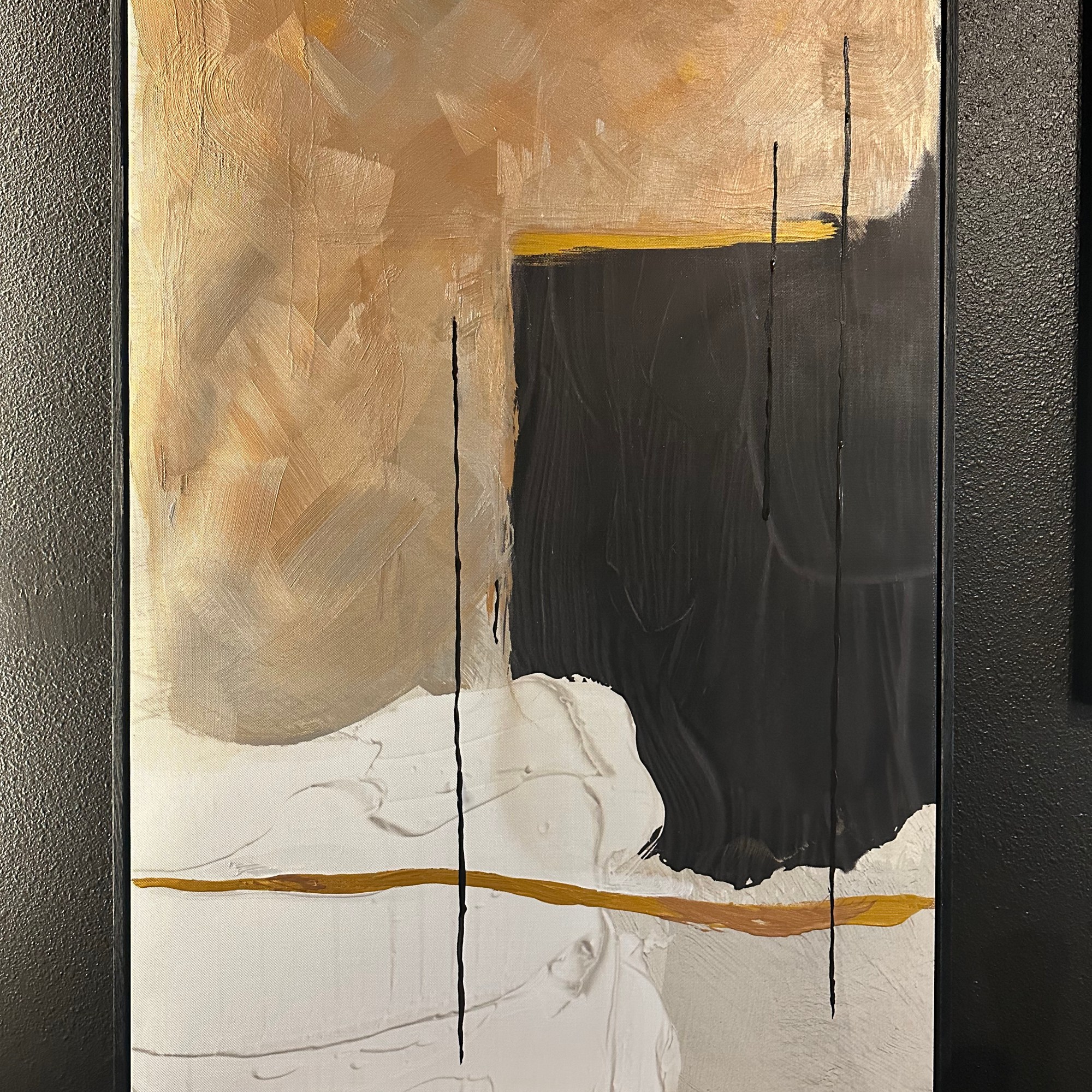
The left and right panels shifted into something architectural. Their heavier geometric forms began to read as heavier structure, something like interior space, or containment maybe walls of a room, boundaries. They frame the central figure without touching her, suggesting both protection and restraint. The thin black lines act as quiet interruptions, marks of presence and intention, guiding the eye towards the center panel without dominating the side panels.
On the center panel feminine shape with long black hair that fall straight down her back, threaded with subtle gold lines that curve, like light caught mid-movement. At the top of her head, gold gathers and lifts, reading not as ornament but as a jeweled crown, symbolic rather than literal. She faces forward, into a wide white field that feels less like space and more like distance. The viewer is invited to stand with her, not behind her, and to look into that unknown white expanse together.
The horizontal gold lines that are present across all three panels was deliberately enlarged but then reduced. They now function as a threshold, a moment of grounding, connecting the trio without resolving it.
This evolution matters deeply to me. Not only because it improves the piece aesthetically, but because it changes its authorship. What began as a commercially produced object has been materially and conceptually altered into a new, original work. The surface has been reworked. The composition redefined. The narrative rewritten.
This is no longer an Amazon artwork. It is a transformed triptych with its own identity, story, and intent.
Crowned Toward the Void
Artist-altered mixed-media triptych on canvas
Artist: Mikhail Oparin
Year: 2026
Format: Triptych (three-panel unified work)
Dimensions: Three panels, each 24 × 36 inches
Status: One of one

Work Description
Crowned Toward the Void is a three-panel abstract composition exploring interior space, presence, and forward gaze. The work exists at the intersection of abstraction and suggested figuration, using restrained geometry, layered brushwork, and controlled metallic accents to establish architectural enclosure and quiet movement.
At the center stands a silhouetted figure viewed from behind. Black forms read as hair cascading down the back, threaded with gold that functions simultaneously as crown, inheritance, and illumination. The surrounding white space becomes distance, horizon, or void, inviting the viewer to look forward alongside the figure rather than at her.
The left and right panels carry visual weight through geometric mass and structure. They suggest walls, rooms, or constructed interiors that frame the central presence without enclosing it. Thin black linear gestures present across all three panels, creating continuity and tension towards center piece without outlining or resolving form. Visible brushstrokes are intentionally created, maintaining depth, movement, and honesty in the surface.
Artist Statement
This piece is about facing forward without spectacle.
At the center, I see the back of a woman. Her black hair runs downward in long curved strokes, marked with gold threads. At the top gold gathers into blotches as nuggets shaping the crown. She does not turn toward us. She looks into white space ahead and, by doing so, places the viewer in that same position of looking forward rather than back.
The side panels feel architectural to me. They carry weight and structure, like interiors or modern buildings, framing the figure without containing her. The thin black lines function as quiet gestures rather than borders. They connect the panels while allowing room for interruption and silence.
I was careful not to over-polish this work. The brushstrokes remain visible. The gold was textured rather than flat. What matters here is quiet narrative. The piece is not about arrival, but about standing still and choosing direction.
Process & Transformation
This work involved extensive repainting, reshaping of surface elements, and the introduction of original black linear gestures. The final composition is materially and visually distinct from its original state and exists as a one-of-one artist-altered work.
Provenance
- Originally acquired as a commercially produced abstract triptych
- Substantially altered and re-authored through original mixed-media intervention
- Finalized as a unified, narrative-driven work by Mikhail Oparin
- No reproductions exist or will be created
This provenance accompanies the work and should remain attached to any future transfer or sale.
Copyright & Authorship
The physical artwork is legally owned by the artist. While the underlying commercial design remains copyrighted by its original creator, the final work presented here represents a lawful, materially altered, and original artistic transformation.
Authorship is claimed solely for the final altered composition.
Artist Valuation
$1,500 USD (complete triptych)
 Mikhail Oparin