


Tagline: Every Day is a Humming Bee Day—Let’s Keep Them Buzzing!
Description:
The National Humming Bee Campaign (NHBC) raises awareness about honey bees’ essential role in ecosystems, beekeeping practices, and threats like Colony Collapse Disorder (CCD). Join us in preserving bee populations and supporting a sustainable planet.
Introduction: The Silent Decline of Insect Populations
Overview
Have you noticed fewer bugs on your windshield during road trips? This phenomenon, dubbed the “windscreen effect,” highlights an alarming trend: insect populations, including honey bees, are rapidly declining. Wildlife experts report a 75% drop in global insect biomass over the past 27 years. Honey bees, essential for pollination and agriculture, face threats from Colony Collapse Disorder (CCD). The Environmental Protection Agency (EPA) cites pesticide use, habitat loss, and climate change as significant contributors to this crisis. Without urgent intervention, the global ecosystem and food security are at risk.
Problem
The disappearance of honey bees poses a direct threat to agriculture and biodiversity. While the quote attributed to Albert Einstein, “If the bee disappears, man would have no more than four years to live”, may be speculative, it underscores the vital interconnection between bees and humans. Honey bees pollinate over $15 billion worth of U.S. crops annually, including staples like apples, berries, and almonds. Their decline could result in billions in economic losses, lower crop yields, and increased production costs. This calls for immediate collective action to protect bee populations and, consequently, our planet.

Media usage and preferences:
Utilizing Google Trends analytics tool 5 search terms were compared. Honey Bee, Beekeeping, Pollinators, Colony Collapse Disease (CCD) over the period from Jan 2004 to present time. (10)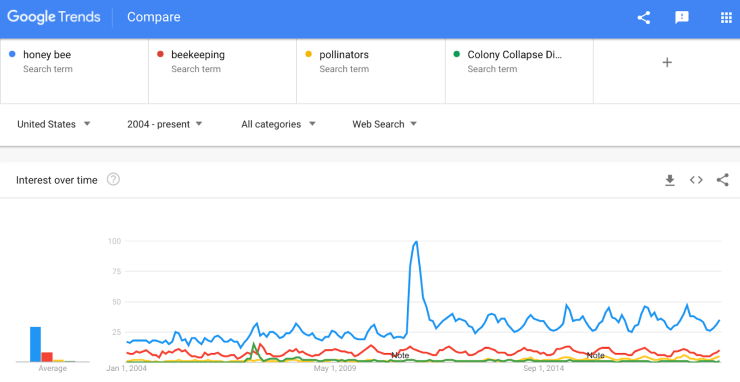
Campaign Theme, Goals & Objectives
Campaign Theme
The National Humming Bee Campaign (NHBC) seeks to amplify awareness of honey bee conservation and insect biodiversity in North America. It aims to unify stakeholders, beekeepers, scientists, and the public, under a common cause: preserving bee populations as part of a healthy ecosystem. By creating positive, nature-focused messaging, NHBC hopes to inspire a nationwide movement for bee conservation and environmental stewardship.
Campaign Objectives
-
- Raise awareness about honey bee population decline and its ecological and economic impacts.
- Serve as an educational hub for research, beekeeping resources, and conservation strategies.
- Unite beekeeping communities and stakeholders in advocating for insect biodiversity and ecosystem health.
- Promote honey bee conservation efforts through public education, community engagement, and fundraising initiatives.
Call to Action
Make every day a Humming Bee Day. Spread awareness, support bee conservation efforts, and be mindful of the essential role honey bees play in our ecosystems.
Campaign Message Profile
Media Strategy
The NHBC will use a blend of earned, owned, and paid media to spread its message. A series of blog posts, research articles, and infographics will be shared across social media platforms to encourage audience participation. Local organizations will be featured, and community-driven events will be promoted to engage a broader audience.
Hashtags for Campaign Messaging:
-
- #KeepEmHumming
- #BeeTheChange
- #BuzzForBees
- #BeeHappy
This strategy aims to generate positive conversations around honey bee conservation, driving public engagement and support for the cause.
Customer Engagement Plan
NHBC’s engagement strategy will follow the natural life cycle of bees. Seasonal content will be produced to reflect the challenges honey bees face throughout the year, from winter survival tips to springtime hive management. Campaigns will culminate in an annual event on National Honey Bee Day in August, bringing together beekeepers, scientists, and the public for a day of awareness and celebration.
Success Metrics:
Each phase of the campaign will be evaluated through data analysis of audience engagement, website traffic, and social media metrics. Regular reports will be generated to assess the impact of messaging strategies and adjust them based on new insights.
Creative Concepts
The NHBC will design a variety of creative assets to promote its message across platforms:
-
- Facebook Ad (Mobile and News Feed)
- Campaign Logo and Header
- Posters and Banners for Events


Work Cited
Knapton, S. (2017, August 26). The windscreen phenomenon: Why your car is no longer covered in dead insects. The Telegraph. https://www.telegraph.co.uk/science/2017/08/26/windscreen-phenomenon-car-no-longer-covered-dead-insects/
Vogel, G. (2017, May 10). Where have all the insects gone? Science. https://www.sciencemag.org/news/2017/05/where-have-all-insects-gone
Hallmann, C. A., Sorg, M., Jongejans, E., Siepel, H., Hofland, N., Schwan, H., Stenmans, W., Müller, A., Sumser, H., Hörren, T., Goulson, D., & de Kroon, H. (2017). More than 75 percent decline over 27 years in total flying insect biomass in protected areas. PLOS One, 12(10), e0185809. https://doi.org/10.1371/journal.pone.0185809
Environmental Protection Agency. (2008). Pollinator protection strategic plan. https://www.epa.gov/pollinator-protection/pollinator-protection-strategic-plan
Saas, J. (2011, March). Why we need bees: Nature’s tiny workers put food on our tables. Natural Resources Defense Council. https://www.nrdc.org/sites/default/files/bees.pdf
 Mikhail Oparin