

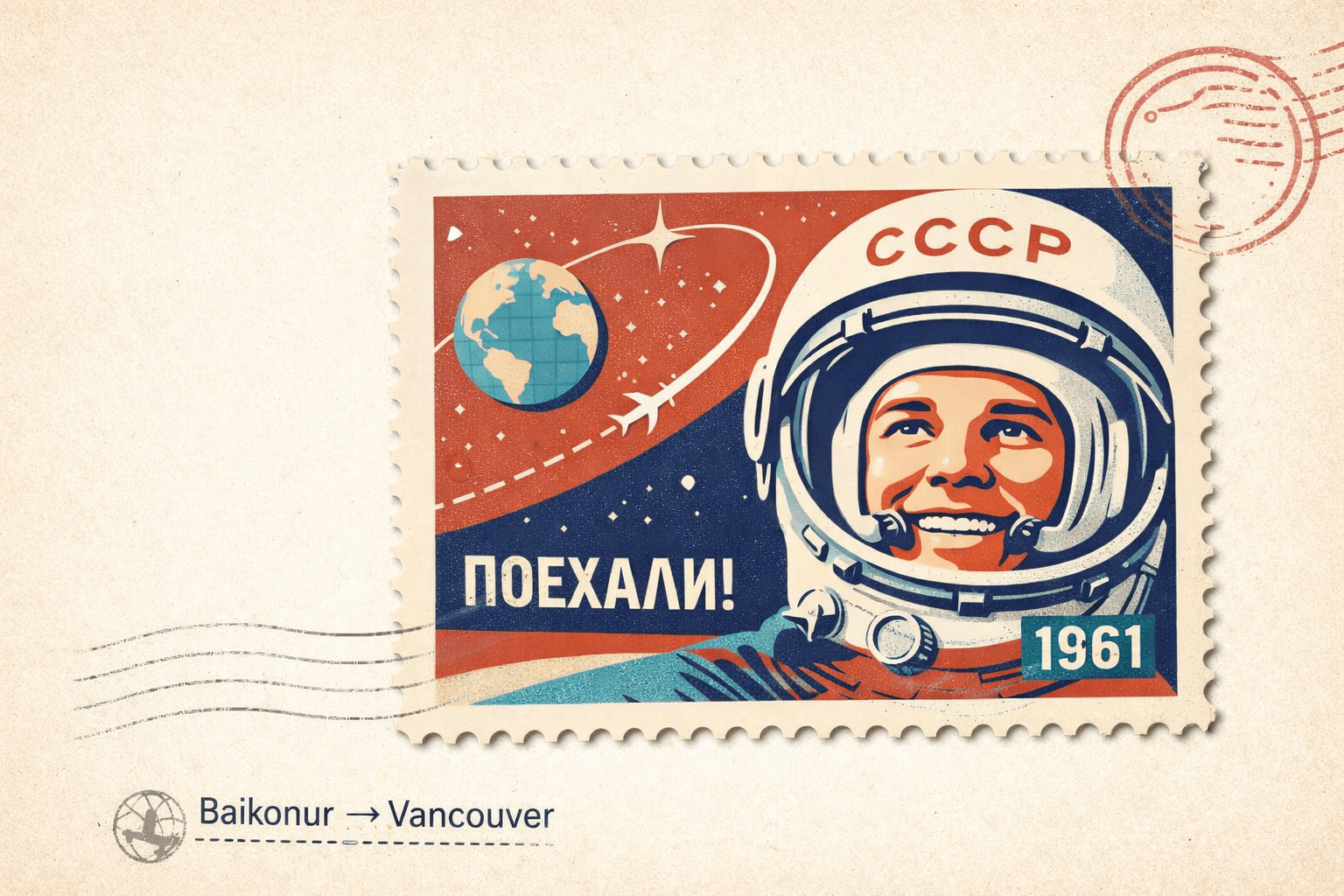
On April 12, 1961, Soviet cosmonaut Yuri Alekseevich Gagarin became the first human to journey into space. The rocket carrying the Vostok 1 spacecraft, with Gagarin aboard, launched from Baikonur Cosmodrome at 6:07 AM local time. Over the course of 108 minutes, Vostok 1 completed an orbit around Earth, marking humanity’s first step into the vast universe and ushering in the era of human spaceflight.
In August 1999, nearly 40 years later, a ceremony was held in Vancouver, Washington, to rededicate the memorial commemorating Chkalov’s historic transpolar flight. Among the distinguished guests from Russia were family members of Chkalov, Seattle’s Consul General, and Gherman Titov—the second man to travel into space.
I was fortunate to videotape this ceremony for CVTV. On the surface, one might think there is no connection between Gagarin and Vancouver, Washington. But I see it differently. Gagarin was the first human to orbit Earth aboard Vostok 1; Titov, who followed, spent 25 hours in space and completed 17 orbits around the planet. And in a surprising twist of history, Gherman Titov set foot in Vancouver, Washington, decades after his pioneering mission.
It is remarkable how our lives often intertwine in ways we don’t immediately recognize. Here, in Vancouver, Washington, Titov walked the grounds of the Fort Vancouver National Historic Reserve and visited the Pearson Air Museum—historical landmarks nearly half a century after his own groundbreaking journey beyond our planet.
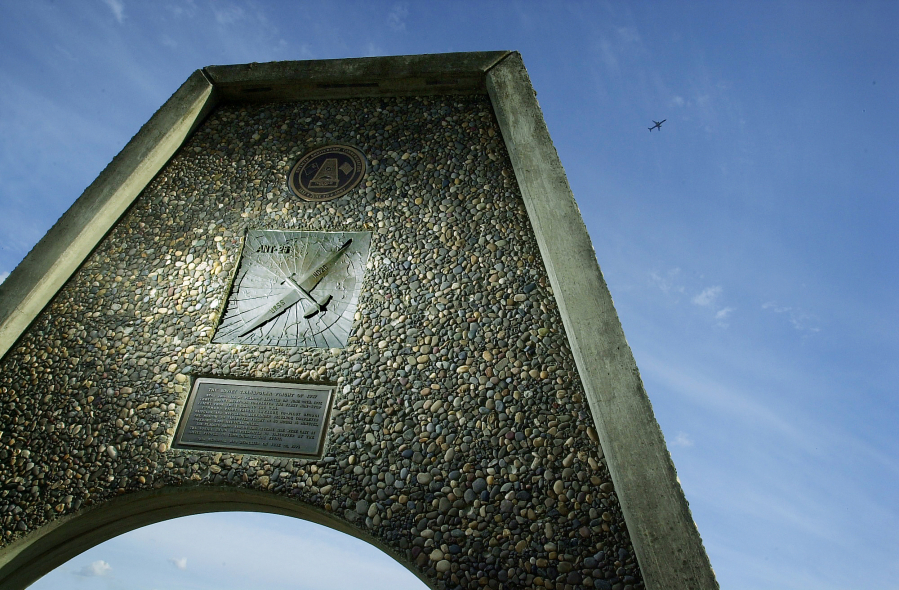
Read more about how a Vancouver monument helped thaw the Cold War >>
Although the event was beautifully organized, with speeches from local government officials, including Mayor Royce Pollard, and the presence of an official delegation from Russia, it largely went unnoticed. Most locals, along with major media outlets from the neighboring city, were unaware that a figure of such historical significance had visited their community.
Yet, to me, it matters. The fact that the second human in space visited our town, even if quietly, became a part of history. It raises a broader question: How often do we overlook significant moments happening around us?
From Baikonur Cosmodrome and the dawn of human spaceflight to Vancouver, Washington, and its connection to aerospace history, today I celebrate—along with the global community—the 50th Anniversary of Spaceflight!
Suggested Sources:
- Siddiqi, A. A. (2000). Challenge to Apollo: The Soviet Union and the space race, 1945-1974. NASA History Division.
- Burgess, C., & Hall, R. (2009). The first Soviet cosmonaut team: Their lives and legacies. Springer-Praxis.
- Harford, J. (1997). Korolev: How one man masterminded the Soviet drive to beat America to the moon. John Wiley & Sons.
- Scott, D., & Leonov, A. (2004). Two sides of the moon: Our story of the Cold War space race. St. Martin’s Press.
- NASA. (2011). 50 years of human spaceflight. Retrieved from https://www.nasa.gov/
 Mikhail Oparin