

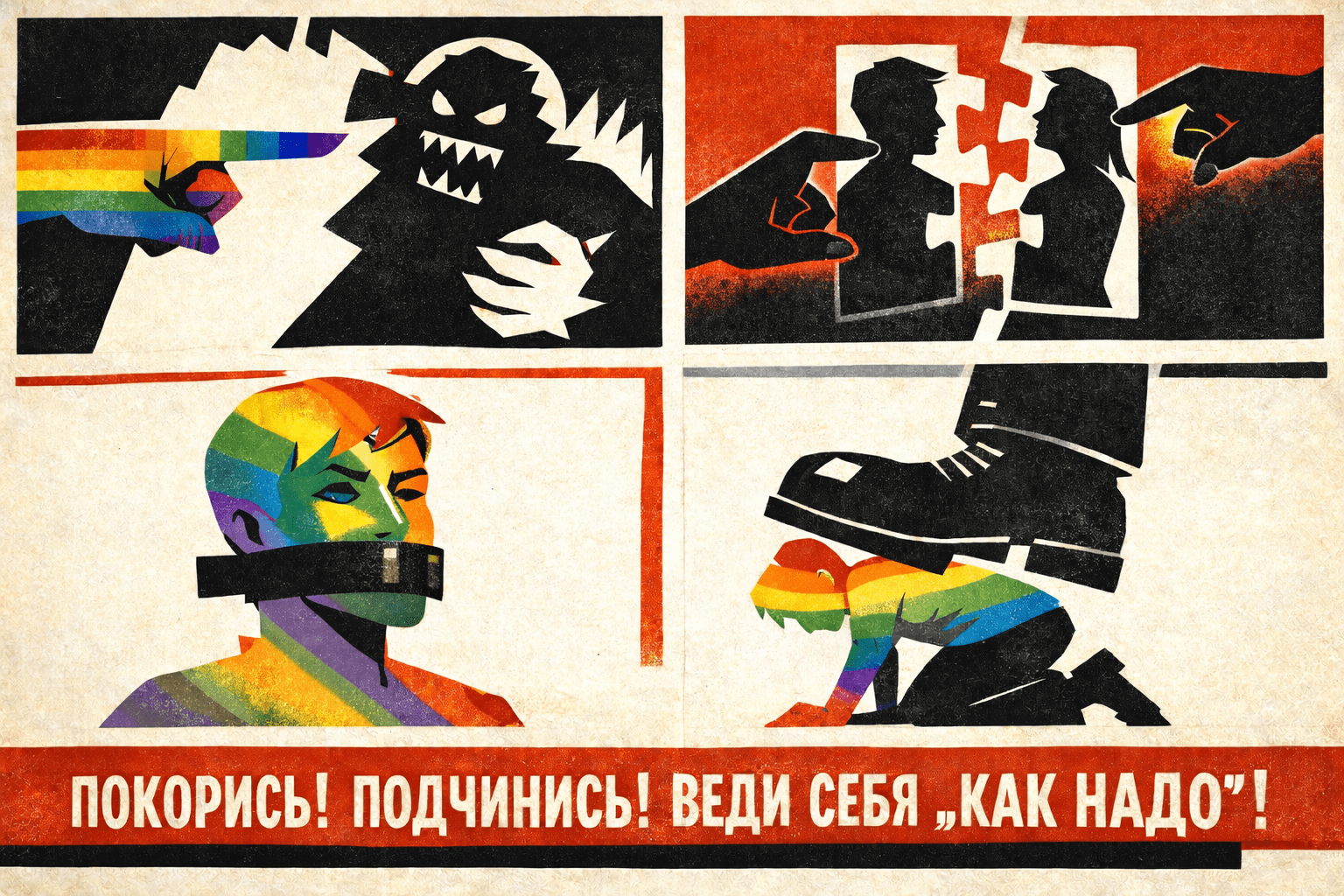
How LGBTQ people became the price of belonging
By the early 2000s, the system I described in Part 1 is no longer fragile. It is stable. It is repeatable. It travels well. So the question reframes, and no longer asks: “How did this style of faith spread?” Now the question asks: “How did LGBTQ people and their nature become one of the easiest targets for attack and demonization, especially in diaspora communities that already feel surrounded by change and external threats of xenophobia and stereotypes?” (Coleman, 2014; Hirschman, 2004; Pew Research Center, 2025)
I am paraphrasing Annie Wilkinson’s 2013 research. In many Russian-speaking faith spaces, rejection is not always expressed as hatred. Often it is expressed as protection of children, family, values and tradition, and the community’s image. The words sound gentle. The effect is not. (Wilkinson, 2013)
The older root: criminalization, shame, and silence
For decades in the Soviet system, male homosexuality was criminalized under Article 121. That history matters even if people do not cite it out loud, because it shaped the emotional default: this topic is not to be discussed, it needs to stay hidden, it associates with danger and punishment. (Healey, 2017; McDonald & Yefanova, 2013)
Even after legal change, the reflex did not disappear. The post-Soviet period did not magically produce open conversations about sexuality. In many families, the topic remained taboo. The silence became inherited. (Healey, 2017)
This is one of the reasons diaspora communities can carry intense discomfort about LGBTQ identity even after migration. People may leave a country, but they still carry the old rulebook in their bodies. Don’t talk about it. Don’t name it. If it shows up, treat it as a threat. You can take the evangelist out of the Soviet Union, but you cannot take the Soviet Union out of the Evangelist.
The 1990s root: collapse, identity repair, and the search for moral certainty
The 1990s were not only an opening for religion. They were an identity crisis for entire populations. Many people experienced rapid economic insecurity, social disorientation, and a loss of shared meaning, shared future. (Pelkmans, 2009; Wanner, 2007)
In that atmosphere, “family order” and “moral clarity” become ever more powerful emotional medicine. They make life feel legible again. They make people feel safe again. (Pelkmans, 2009) They also create a simple social map: insiders (us), outsiders (them), the clean (us), the contaminated (them), the faithful (us), the dangerous (them).
This is where LGBTQ people become useful to the system. Not as human beings, but as a symbol of “them”. A warning sign, a boundary marker, a test of loyalty. Are you with us or are you the other.
The community develops and learns a script that goes like this:
- We are under attack.
- The outside world is corrupt.
- We must protect our children.
- We must protect our family.
- If we compromise on this, we lose everything.
This is not only religious. It becomes political. It becomes cultural. It becomes the language of belonging. (Wilkinson, 2013)
The accelerant: Russia turns “traditional values” into state messaging
At a certain point, this stops being just “diaspora culture” or “church culture.” It becomes much louder, because the Russian state begins to treat LGBTQ visibility itself as a public threat. (Wilkinson, 2013)
A major turning point is the 2013 federal “propaganda” law framed LGBTQ information as something children must be protected against, which gave ordinary discrimination a legal and moral foundation. (Human Dignity Trust, 2014; Human Rights Watch, 2018)
Then, in December 2022, Russia further expanded these restrictions so they apply far beyond minors, widening censorship and enforcement across public life. (Human Rights Watch, 2022; Reuters, 2022)
In November 2023, Russia’s Supreme Court labeled what it called the “international LGBT movement” as extremist, and human rights monitors warned the decision was so vague it could be used against ordinary expressions of solidarity and identity. (Human Rights Watch, 2023; Office of the United Nations High Commissioner for Human Rights, 2023)
I am not writing this to turn my essay into a Russia-only story. I am writing this because Russia’s messaging is one of the loudest engines shaping the Russian-speaking information space, including what diaspora communities hear, repeat, and normalize. When a state frames LGBTQ identity as extremist or corrupting, it demonizes the identity and gives parents, grandparents, aunts and uncles, church leaders, community associations, community influences, radio hosts, and cultural and moral gatekeepers permission to problematize, dehumanize and demonize LGBTQ identities. (Human Rights Watch, 2023; Office of the United Nations High Commissioner for Human Rights, 2023)
It also gives families a way to feel righteous while causing harm often to their own kin. The rhetoric sounds like “values.” The result is exclusion, hatred, threat to life and happiness.
How the script becomes portable: media, repetition, and emotional training
Once the system is media-driven, in the hands of skillful communicators it becomes catalyzed and can reproduce itself anywhere. (Coleman, 2014)
A sermon preached in one place can be watched in another. A talk show filmed in one city can shape the language in a church across the ocean. A clip can circulate in family group chats and become “common sense” without anyone checking where it came from.
This is how the culture travels:
- Short videos that simplify complex issues into threats
- “Concerned” discussions that frame LGBTQ life as contagion
- Testimony-driven storytelling that rewards conformity
- Leaders who speak in the language of warmth while tightening control
- Constant repetition until the audience stops hearing it as an opinion and starts hearing it as reality
Familiar rhetoric, isn’t it? When you see this clearly, you stop treating it as random personal prejudice. It trains, conditions, and repeats an emotional pattern. (Coleman, 2014)
How it lands in diaspora life, right here
The part that matters most to me is what happens after the message leaves the screen and enters a family.
In diaspora communities, faith spaces often function as more than religion. They are language, belonging, and a place where people do not have to translate themselves every day. (Ebaugh & Chafetz, 2000; Hirschman, 2004)
That is why the script is so effective. It can arrive wrapped in affection and framed as protection, while still demanding silence and self-erasure from the person it targets.
Where this goes next
In Part 3, I focus on the delivery system in detail: how this script is carried through media and repetition, how it gains authority, and what it does to relationships once it becomes “common sense.”
This is not just “over there,” and it is not just someone else’s conflict. It is a system that reaches families where they live.
References
Coleman, S. (2014). Only dis-connect: Pentecostal global networking as revelation and concealment. Ethnos, 79(3), 363–385. https://doi.org/10.1080/00141844.2012.718232
Ebaugh, H. R. F., & Chafetz, J. S. (Eds.). (2000). Religion and the new immigrants: Continuities and adaptations in immigrant congregations. AltaMira Press.
Healey, D. (2017). Russian homophobia from Stalin to Sochi. Bloomsbury Academic.
Hirschman, C. (2004). The role of religion in the origins and adaptation of immigrant groups in the United States. International Migration Review, 38(3), 1206–1233. https://doi.org/10.1111/j.1747-7379.2004.tb00233.x
Human Dignity Trust. (2014, April 24). Russia: The “anti-propaganda” law (Briefing). https://www.humandignitytrust.org/wp-content/uploads/resources/Briefing_on_Russias_federal_anti-propaganda_law.pdf
Human Rights Watch. (2018, December 11). No support: Russia’s “gay propaganda” law imperils LGBT youth. https://www.hrw.org/report/2018/12/12/no-support/russias-gay-propaganda-law-imperils-lgbt-youth
Human Rights Watch. (2022, November 25). Russia: Expanded “gay propaganda” ban progresses toward law. https://www.hrw.org/news/2022/11/25/russia-expanded-gay-propaganda-ban-progresses-toward-law
Human Rights Watch. (2023, November 30). Russia: Supreme Court bans “LGBT movement” as “extremist”. https://www.hrw.org/news/2023/11/30/russia-supreme-court-bans-lgbt-movement-extremist
McDonald, T., & Yefanova, N. (2013, June 21). Anti-gay propaganda laws in Russia (Memorandum to the Council for Global Equality). https://www.globalequality.org/storage/documents/pdf/russian%20anti-gay%20law%20-%20corporate%20memo%20final.pdf
Office of the United Nations High Commissioner for Human Rights. (2023, November 30). Russia: UN Human Rights Chief deplores Supreme Court’s decision to outlaw “LGBT movement”. https://www.ohchr.org/en/press-releases/2023/11/russia-un-human-rights-chief-deplores-supreme-courts-decision-outlaw-lgbt
Pelkmans, M. (Ed.). (2009). Conversion after socialism: Disruptions, modernisms and technologies of faith in the former Soviet Union. Berghahn Books. https://doi.org/10.3167/9781845456177
Pew Research Center. (2025, May 20). How much discrimination do Americans say groups face in the U.S.? https://www.pewresearch.org/politics/2025/05/20/how-much-discrimination-do-americans-say-groups-face-in-the-u-s/
Reuters. (2022, December 5). Putin signs law expanding Russia’s rules against ‘LGBT propaganda’. Reuters. https://www.reuters.com/world/europe/putin-signs-law-expanding-russias-rules-against-lgbt-propaganda-2022-12-05/
Wanner, C. (2007). Communities of the converted: Ukrainians and global evangelicalism. Cornell University Press.
Wilkinson, C. (2013, November 8). Putting traditional values into practice: Russia’s anti-gay laws. Russian Analytical Digest, (138), 5–7. https://css.ethz.ch/content/dam/ethz/special-interest/gess/cis/center-for-securities-studies/pdfs/RAD-138-5-7.pdf
 Mikhail Oparin