

I arrive at my position on ethics through discomfort, not through certainty. By listening to real conversations with friends, neighbors, and community members, I notice how quickly concern turns into condemnation. I’m not certain this argument is complete. I wrote it after watching how quickly judgment replaces curiosity in public discourse, and I’m still unsure where the line should be drawn.
My question has never been whether harm exists. It is whether our response to harm preserves the very values we claim to defend.
I often hear urgency. People speak in absolutes. “This is unacceptable.” “There is no excuse.” “We know who they are now.” These voices do not always come from ill intent. Often, they come from being tired or exhausted, from accumulation of frustration, and a desire to protect others from further harm. But urgency comes at a cost when outrage becomes the primary moral signal, complexity disappears and the Scales of Justice shift.
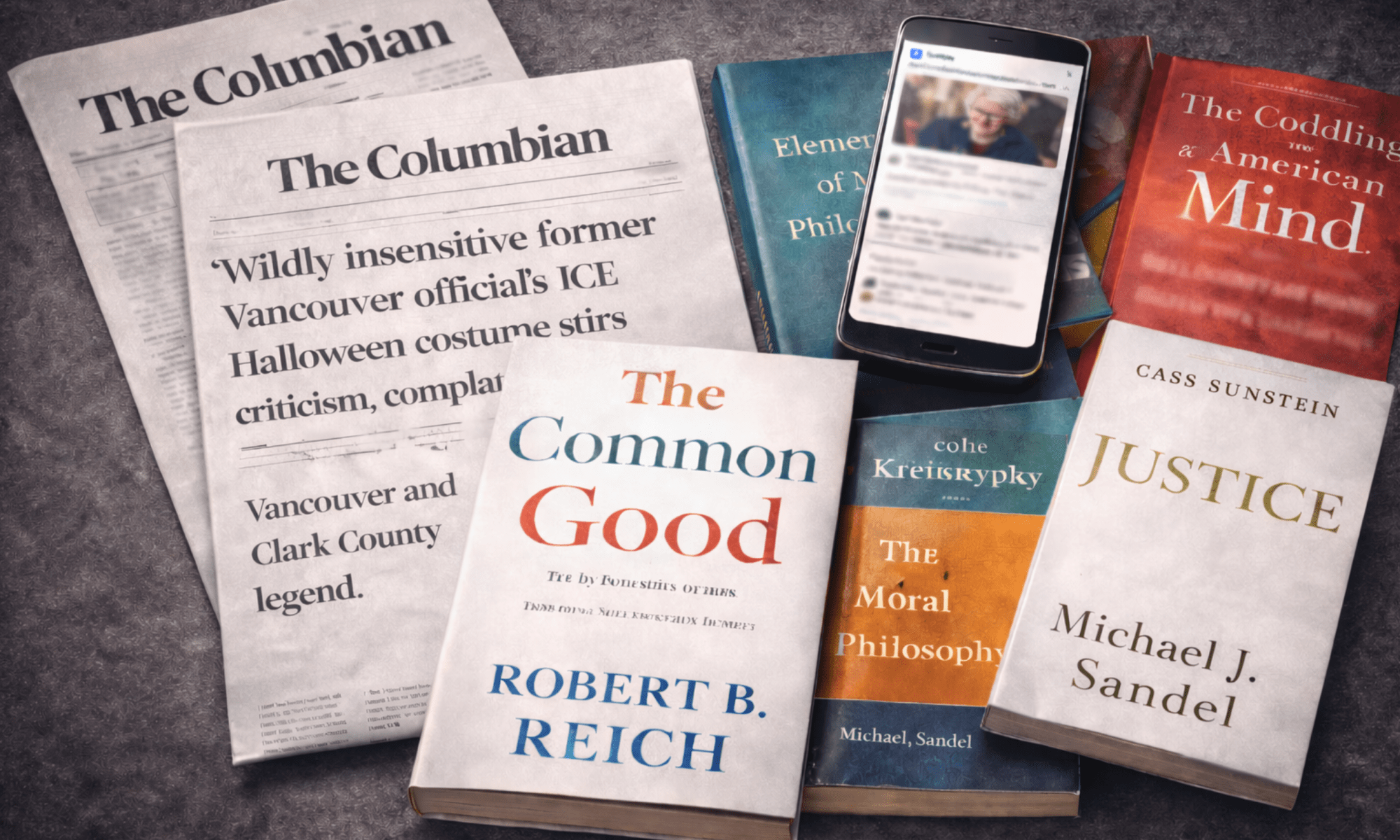
Ethical theory warns us about this repeatedly and quietly. Rachels reminds us that morality does not stand on instinct alone, but reasoned on reflection. Sandel cautions that justice without proportionality becomes coercive. Reich frames the common good not as agreement, but as shared obligation across difference. None of these thinkers deny harm, instead they ask how judgment is exercised, and to what end.
In public life, in media, and at the round table with friends I hear a different refrain: “Accountability means consequences,” “Silence is complicity,” “If you are not condemning, you are excusing.” These statements circulate rapidly, often detached from context. A person’s history collapses into a screenshot, erasing decades of service and flatten their complexity into a single act. The conversation ends not with repair, but with harm and erasure.
From an ethical standpoint, this is not clarity. It is certainty masquerading as virtue.
I have seen this dynamic unfold close to home. Public figures are reduced overnight to symbols of failure, not through careful inquiry, but through collective acceleration. The language shifts quickly. It stops asking what happened or what should change, and begins asking who should disappear. This is not accountability as ethical theory understands it. It is punishment with no path forward.
Ethics, as taught and as lived, insists on something harder. It asks us to hold multiple truths at once. That harm can be real. That intent still matters. That history counts. That consequences must be proportional. And that moral judgment, if it is to serve the common good, must leave room for repair.
The voices around me often resist this. “Why should we care about their feelings?” “They should have known better.” “This is how change happens.” These are not frivolous arguments. They express real pain and a real desire for justice. But ethical reasoning presses back gently. It asks whether a system that relies on fear produces better behavior, or simply quieter participation. It asks who remains in public life when the cost of mistake becomes social exile.
Research on civic trust and institutional health aligns with this concern. Communities governed by fear become brittle. Participation narrows. Only the most insulated or the most extreme remain visible. Everyone else withdraws. Ethics is not only about judging individuals. It is about sustaining the conditions under which collective life remains possible.
My own voice sits uncomfortably in the middle of this conversation. I am not arguing for leniency without responsibility. I am arguing for accountability that does not confuse destruction with justice. For ethics that understands restraint as strength, not weakness. For a moral culture that values repair over performance.
This is where literature and lived experience converge. Ethical frameworks do not exist to absolve wrongdoing. They exist to prevent moral collapse. They remind us that punishment alone does not heal harm, and that communities which abandon proportion eventually abandon trust.
When I say that ethics is what holds us together, I mean this quite literally. Ethics is the discipline that keeps judgment from turning into cruelty. It is what prevents moral certainty from erasing humanity. It is what allows a community to say, “This caused harm,” without also saying, “You no longer belong to us.”
The question is not whether we respond to harm. The question is whether our response builds a future or forecloses one.
That is not a theoretical concern. It is a civic one. And it is the ethical work of our time.
References
Ethical Theory and Moral Reasoning
Rachels, J., & Rachels, S. (2019).
The elements of moral philosophy (9th ed.). McGraw-Hill Education.Sandel, M. J. (2009).
Justice: What’s the right thing to do? Farrar, Straus and Giroux.Reich, R. B. (2018).
The common good. Alfred A. Knopf.Civic Life, Trust, and Public Discourse
Haidt, J., & Lukianoff, G. (2018).
The coddling of the American mind: How good intentions and bad ideas are setting up a generation for failure. Penguin Press.Sunstein, C. R. (2001).
Republic.com. Princeton University Press.Educational and Community Context
Washington State University, Edward R. Murrow College of Communication. (2018).
Ethics for professionals coursework and seminar discussions, Spring 2018.
 Mikhail Oparin