

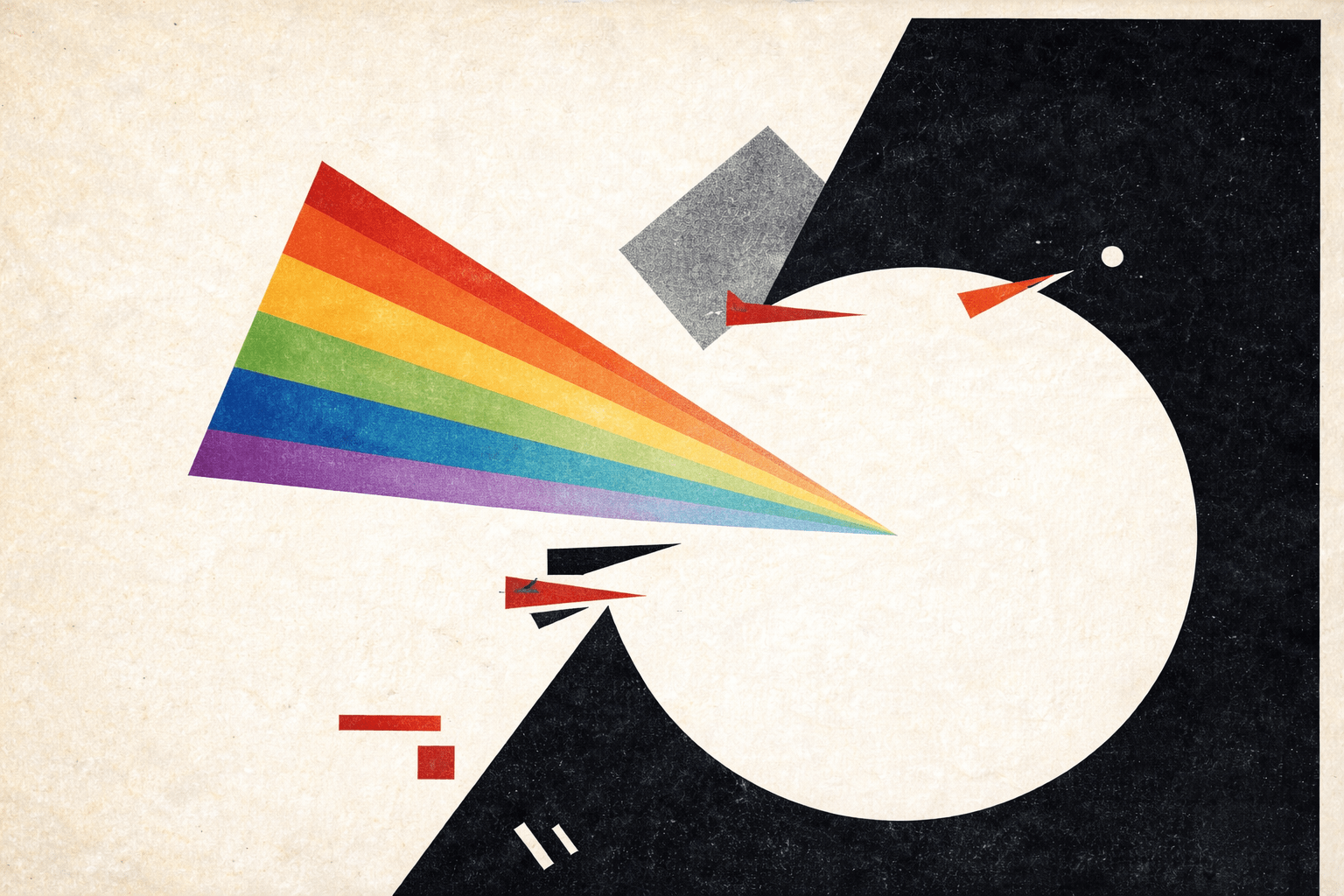
How a diaspora faith culture learns the language of love, then makes LGBTQ people the price of belonging.
I’m writing this because what happened in my family is not rare. It’s a pattern that travels.
I wrote the earlier essays from inside the experience. I tried to name what it feels like to be treated with warmth in words but kept at a distance in real life, especially when faith is used to explain that distance as “truth.” (Oparin, 2025a, 2025b, 2025c, 2025d, 2026) After a while, I realized I could not stay only in the personal story. If I kept writing only about my experience and feelings, it would be too easy for someone to dismiss it as private family conflict or something else entirely. This essay exists because I needed to understand the larger pattern, how a certain diaspora faith culture can sound relational and loving, yet still train people to see LGBTQ lives as a threat, or as a problem to solve, or as a line that must not be crossed. I start with the historical conditions that shaped the system, then I move forward into how it functions now, not only “over there,” but in the everyday lives of people who live all over the world today. My goal here is context, not revenge. I want to trace how the script gets built, so I can tell the truth about my life without framing myself through the lens assigned to me by many (not all) people of evangelical faith.
How to read this essay
This is a layered essay. I am conducting two things at once.
First, I am providing a timeline. I do not claim to provide a complete line-by-line timeline, but provide a sequence that shows how a certain style of faith, leadership, and media became portable, replicable and in a format that many ministries use today. (Coleman, 2014; Anderson, 2013)
Second, I am calling out a pattern that shows up in real life today. Not just a geographic regions or one country, but wherever the diaspora lives. In churches, family chats, YouTube channels, and “concerned” conversations that sound gentle but carry a threat underneath to specific people within our communities. (Wanner, 2007)
I am using publicly available sources that are widely cited in scholarship. I include citations inside the text and provide a reference list at the end. However, this essay is not meant to be a comprehensive history. It is takes a reader to the point I make in this series that shows how that rules are built, how inception is placed in peoples minds on how to treat LGBTQ like a threat, and how the thought spreads through videos, sermons, and family talk until it starts changing real relationships.
I’m using publicly available sources that are widely cited in scholarship. I include citations in the text and a reference list at the end. This essay is not a comprehensive history. It’s a map that takes you to the point I’m making across this series: how a set of rules gets built, how the idea is planted that LGBTQ people are a threat, and how that message spreads through videos, sermons, and family talk until it starts changing real relationships.
A note on terms
I will use the phrase post-Soviet in the early sections because it describes a real transitional period in the 1990s. Many countries were reshaping law, identity, and public life at the same time, after the USSR collapsed. (Pelkmans, 2009)
But I will not stay in that language forever. When the timeline reaches the 2000s and beyond, I will name the present tense more directly. This includes Russia’s geopolitical and global influence, because this country, while cradling the bones of my family and loved ones, it continues to hurt me as an individual person through being one of the most powerful engines of anti-LGBTQ messaging in the Russian-speaking world today.
Still, the focus of this essay is not me, but a map. The focus is the diaspora. And the point is how these ideas travel, repeat, and shape ordinary people, and their lives far from where both took the root.
The ground that formed this culture
1920s–1940s: survival faith and the habit of guarded belonging
Long before the polished ministries, granduouse arenas, interconnected media and networks brought international conferences, or Christian television networks, to our homes, evangelical and Pentecostal believers inside the Soviet system learned a basic lesson: do not attract attention. (Kolarz, 1961)
Religion was heavily restricted. Public religious education and organizations were not treated as normal civic life of the country’s citizens. They were treated as suspects. Over time, faith turned underground and was practiced quietly, often in private homes, within tightly closed and trusted circles. (Seventeen Moments in Soviet History, 1929; Fedorenko, 2021)
Communities survived through the conditions that shaped them. They learned a carefully guarded form of belonging. They learned to separate outsiders from insiders. That survival instinct did not identify as hate, but it became a foundation for definitive boundary culture later. When a community learns that safety depends on conformity, difference begins to look dangerous. (Kolarz, 1961)
1960s–1970s: regulation, oversight, and a faith trained in the private sphere
In the later Soviet period, religion was managed through state oversight. Faith communities could exist, but only under conditions that kept them fully transparent and controllable. Being registered and monitored by government meant the pressure would increase or decrease depending on the political climate of the controlling hand of the party. (Anderson, 1991)
This matters for the diaspora story because it trained a specific position toward the world through the lens of the environment controlled by the authoritative government. It made faith face inward. It made family and church the primary units of trust (I agree on the former, but question the latter). It also created a cultural reflex where public disagreement is treated as betrayal, and moral deviation is a threat to group’s survival.
Many believers learned to speak with two voices. One voice was used for the public life. The other voice was for the inner circle. That split did not disappear when the USSR disappeared. In many spaces it simply changed its object. Instead of fearing the state, people learned to fear “corruption,” “Western influence,” and later, “the LGBTQ agenda.” The structure stayed familiar: protect the group by controlling the narrative within and the boundary. (Pelkmans, 2009)
Late 1960s–early 1980s: renewal currents inside Soviet evangelical life
Before Western charismatic systems arrived in full force, parts of the Soviet evangelical world were already experiencing renewal movements that emphasized spiritual experience, gifts of the Spirit, and emotionally engaged worship. For example, in Baltic Republics, scholars describe the waves of charismatic renewal that was reshaping evangelical communities and creating networks and setting the stage for imported neo-charismatic models. (Ringvee, 2015)
I am not romanticizing this, but pointing out that the ground was already prepared for a certain kind of spiritual style. When the iron curtain fell, the shift was not just theological. It was emotional, aesthetic, and cultural, revolutionary in its worth.
Late 1970s–1980s: a scalable Western model develops outside the Soviet world
While the Soviet religious landscape was constrained, charismatic evangelical movements in the West were developing a different kind of structure. It was more repeatable. It was more leader-centered. It was often more confident about authority, in a packaged format. (Bowler, 2013; Coleman, 2014)
This is where you begin noticing a model that can be taught, franchised, exported, and reproduced as a form of a business model. Bible schools with packaged curricula. Training pipelines. Conference circuits. Media ministries that treat storytelling and testimony as tools for growth. Fundraising logic that is standardized. A language of intimacy that is packaged as a scalable model.
This is also where “connection language” becomes a strategy, not only a virtue. The tone is warm. The message feels personal. The authority is centralized. The boundary is firm and private. (Coleman, 2014)
Again, I am not saying every Western evangelical is the same. I am describing a model that later became influential in Russian-speaking evangelical culture, especially through training networks.
1990–mid 1990s: the opening and the transfer
When the Soviet system collapsed, religion did not simply “return.” It restructured, reorganized, reshaped itself. It evolved into a different form. (Codevilla, 1991; Pelkmans, 2009)
The early 1990s after the fall of the Soviet Union created new legal space for religious organizations, foreign partnerships, and public ministry to enter the geopolitical space. That opening made large-scale transfer possible for the first time in history. Western groups entered the former Soviet space with humanitarian aid, Bible distribution, leadership training, and church planting strategies. Many people were starved for the new meaning after decades of official atheism. Many were also exhausted and economically crushed. That combination made populations receptive to anyone offering certainty, structure, and hope. (Pelkmans, 2009)
This is the moment when a modern diaspora faith culture begins to take its recognizable form we see today. The ministry system obtained the tools to become portable, replicable format through training pipelines, media channels, and leadership networks. The diaspora suddenly had room to expand. (Coleman, 2014)
Training hubs outside the former Soviet space became especially important. Bible schools, mission programs, and regional gateways in places like Scandinavia and the Baltics helped form leaders who later carried these models across borders. People trained in one place could return and reproduce the same style somewhere else, in the same language, with the same emotional and organizational script. (Livets Ord, n.d.-a, n.d.-b; Ringvee, 2015)
At this point, “post-Soviet” space is still the right word. The shared experience of collapse, rebuilding, and identity repair is still fresh. But the story does not stop here. (Pelkmans, 2009)
Mid 1990s–2000s: a hybrid system settles in and becomes repeatable
As the 1990s progressed, the imported structures and the local cultures began to blend and influence everything within it. (Pelkmans, 2009)
What emerged was a hybrid: Western-style charismatic systems combined with Russian-speaking cultural expectations, family hierarchy, and a strong desire for moral certainty after social chaos. This is where you start to see a stable pattern that will later travel with the diaspora across borders: (Pelkmans, 2009; Wanner, 2007)
- strong pastoral authority
- emotionally shaped messaging
- clear insider and outsider categories
- “family values” as a spiritual badge
- media as a ministry engine, not a side project
- moral conflict framed as spiritual warfare
By the early 2000s, this approach was no longer an experiment. It was a system. (Wanner, 2007)
And once a system becomes repeatable, it becomes exportable. It can be carried into immigrant communities. It can be broadcast from one city and absorbed in another. It can feel local everywhere, even when its script was built elsewhere. (Coleman, 2014; Wanner, 2007)
References
Anderson, A. (2013). To the ends of the earth: Pentecostalism and the transformation of world Christianity. Oxford University Press.
Anderson, J. P. (1991). The Council for Religious Affairs and the shaping of Soviet religious policy. Soviet Studies, 43(4), 689–710. https://doi.org/10.1080/09668139108411907
Bowler, K. (2013). Blessed: A history of the American prosperity gospel. Oxford University Press.
Codevilla, A. (1991). A commentary on the new Soviet law on freedom of conscience and religious organizations. Religion in Communist Lands, 19(1–2), 119–145. https://doi.org/10.1080/09637499108431668
Coleman, S. (2014). Only dis-connect: Pentecostal global networking as revelation and concealment. Ethnos, 79(3), 363–385. https://doi.org/10.1080/00141844.2012.718232
Fedorenko, M. (2021). Protestant Pentecostals in the post-war repression in the Soviet Union (1940s–1950s). Religion in Eastern Europe, 41(4), 59–80. https://digitalcommons.georgefox.edu/ree/vol41/iss4/4/
Kolarz, W. (1961). Religion in the Soviet Union. St. Martin’s Press.
Livets Ord. (n.d.-a). About us. Retrieved January 31, 2026, from https://www.livetsord.se/en/about-us/
Livets Ord. (n.d.-b). LOBC: Word of Life Bible Center. Retrieved January 31, 2026, from https://www.livetsord.se/en/lobc/
Oparin, M. (2025, May 10). Reflecting family, faith, and the limits of belonging. https://mikhailoparin.com/2025/05/10/reflecting-family-faith-and-the-limits-of-belonging/
Oparin, M. (2025, May 11). Navigating identity, family, and belonging: A secular perspective on reconciliation with evangelical loved ones. https://mikhailoparin.com/2025/05/11/navigating-identity-family-and-belonging/
Oparin, M. (2025, May 24). Bridges built, burned. https://mikhailoparin.com/2025/05/24/bridges-built-burned/
Oparin, M. (2025, October 31). Edward Scissorhands: When compassion isn’t enough. https://mikhailoparin.com/2025/10/31/edward-scissorhands-when-compassion-isnt-enough/
Oparin, M. (2026, January 5). Breaking the spell: My moral stand against manipulative faith. https://mikhailoparin.com/2026/01/05/breaking-the-spell-my-moral-stand-against-manipulative-faith/
Pelkmans, M. (Ed.). (2009). Conversion after socialism: Disruptions, modernisms and technologies of faith in the former Soviet Union. Berghahn Books.
Ringvee, R. (2015). Charismatic Christianity and Pentecostal churches in Estonia. Approaching Religion, 5(1), 39–51. https://doi.org/10.30664/ar.67563
Seventeen Moments in Soviet History. (1929). Law on religious organizations. Michigan State University. Retrieved January 31, 2026, from https://soviethistory.msu.edu/1929/churches-closed/churches-closed-texts/law-on-religious-organizations/
Wanner, C. (2007). Communities of the converted: Ukrainians and global evangelicalism. Cornell University Press.
 Mikhail Oparin